Monitoring my Eaton Ellipse PRO 650 on Zabbix with Zabbix agent and Apcupsd.
This is how to monitor an Eaton Ellipse PRO 650 with Zabbix using Zabbix agent and Apcupsd.
Required
- Have
zabbix-agent2installed on your node and you will need a Zabbix server somewhere. - And also install
jq. - And of course you will need a configured
apcupsd, Ubuntu has a good tutorial for that.
Check everyting is setup
$ apcupsd --version
apcupsd 3.14.14 (31 May 2016) debian
$ jq --version
jq-1.6
$ zabbix_agent2 --version
zabbix_agent2 (Zabbix) 6.4.13
Config files
Create /etc/zabbix/zabbix_agent2.d/userparameter_apcupsd.conf
With:
UserParameter=apcupsd,apcaccess | jq -s -R -f /etc/zabbix/zabbix_agent2.d/apcupsd_filter.jqCreate /etc/zabbix/zabbix_agent2.d/apcupsd_filter.jq
# See https://linux.die.net/man/8/apcaccess
# Newer versions of jq will have `trim` and some of this mess can be cleaned up
# See: https://github.com/jqlang/jq/issues/3078#issuecomment-2018999435
[

    split("\n")[] # transform input into array
    | split(": ") # where first element has key names
    | select(length==2) # check we have a key and a value
    | (
       # If the value contains some string or if the key is NUMXFERS
       if (.[1] | test("Seconds|Volts|Percent|Minutes|Hz"; "x")) or (.[0] | test("NUMXFERS"; "x"))
                      then
                        {(.[0]|split(" ")[0]):.[1]|split(" ")[0]|tonumber}
                      else
                        {(.[0]|split(" ")[0]): .[1]|rtrimstr(" ")|rtrimstr(" ")}
                      end
       )
]
| add
Check that it works
Run:
apcaccess | jq -s -R -f /etc/zabbix/zabbix_agent2.d/apcupsd_filter.jqIt outputs:
See: man apcaccess for the keys descriptions.
{
  "APC": "001,029,0691",
  "DATE": "2024-04-07 16:38:34 +0200",
  "HOSTNAME": "my-machine",
  "VERSION": "3.14.14 (31 May 2016) debian",
  "UPSNAME": "ET_MYUPS",
  "CABLE": "USB Cable",
  "DRIVER": "USB UPS Driver",
  "UPSMODE": "Stand Alone",
  "STARTTIME": "2024-04-07 14:01:53 +0200",
  "MODEL": "Ellipse PRO",
  "STATUS": "ONLINE",
  "LOADPCT": 10,
  "BCHARGE": 72,
  "TIMELEFT": 34.1,
  "MBATTCHG": 45,
  "MINTIMEL": 30,
  "MAXTIME": 0,
  "OUTPUTV": 233,
  "DWAKE": -1,
  "LOTRANS": 165,
  "HITRANS": 285,
  "ALARMDEL": 30,
  "LINEFREQ": 50,
  "NUMXFERS": 0,
  "TONBATT": 0,
  "CUMONBATT": 0,
  "XOFFBATT": "N/A",
  "STATFLAG": "0x05000008",
  "SERIALNO": "PXXXHXXABD",
  "END": "2024-04-07 16:39:25 +0200"
}
Zabbix setup
Download the template: Zabbix-UPS-Apcupsd.yaml
Import the template in "Data Collection" > "Templates".
Then go to your "Host" and link the template in the "Templates" section.
Set the nominal wattage (required)
The template has one required host macro, {$APC_NOM_WATTS}. It has no default value on purpose: the watts item stays unsupported until you set it, rather than reporting a plausible but wrong number.
It must be the watt rating from the UPS label, not the VA rating. A unit sold as "650" is usually 650 VA and 400 W; using 650 over-reports consumption by about 1.6×.
Read it from the device when the driver reports it:
apcaccess | grep NOMPOWERIf your model reports it, the output is in watts:
NOMPOWER : 400 WattsIf it prints nothing and exits 1, the model does not report its rating at all. That is not a broken apcaccess: APC's USB HID models, the Ellipse PRO range included, expose 30 fields and NOMPOWER is not one of them. Confirm with:
apcaccess | cut -d: -f1 | tr -s ' 'If NOMPOWER is absent from that list, the rating cannot be read from the device and must come from the label or the datasheet.
NOMPOWER is an apcupsd field, so this only concerns APC units — apcupsd drives APC hardware exclusively. Eaton, MGE and other brands are handled by NUT, where the equivalent value is ups.realpower.nominal and is equally absent on many models.
Finding it from the UPS display
If the label is out of reach, the display gives it back. LOADPCT is measured, so with the watt figure the LCD shows, the nominal is:
nominal ≈ LCD watts × 100 / LOADPCTSample LOADPCT over a few seconds before using it, it follows the real load. Without a delay every reading lands in the same second and you get one value repeated:
for i in 1 2 3 4 5; do
  apcaccess | awk -F: '/^LOADPCT/{gsub(/ /,"",$2); print $2}'
  sleep 2
done
On an APC Ellipse PRO 650 the LCD showed 30 W at a steady 8 %: 30 × 100 / 8 = 375, which is the 400 W rating of that unit — 650 is its VA rating.
Then set it on the host: Data collection → Hosts → your host → Macros → Inherited and host macros, and add the macro below:
| measured LCD load | steady LOADPCT | set {$APC_NOM_WATTS} |
|---|---|---|
| 30 W | 8 % | 400 |
| 100 W | 25 % | 400 |
| 150 W | 37 % | 400 |
| 250 W | 62 % | 400 |
The value is a property of the UPS, not of the load: pick the nominal whose multiplication reproduces the LCD figure, and every row above gives 400.
Check the result against the UPS display. The watts item is load% × nominal, rounded by both the device and the LCD, so a few watts of difference is normal:
LOADPCT   : 7.0 Percent
7 % × 400 = 28 W        (LCD shows 30 W)
If the item shows a number that is far off, the macro is the wrong rating — the load percentage itself is read directly from the device and is reliable.
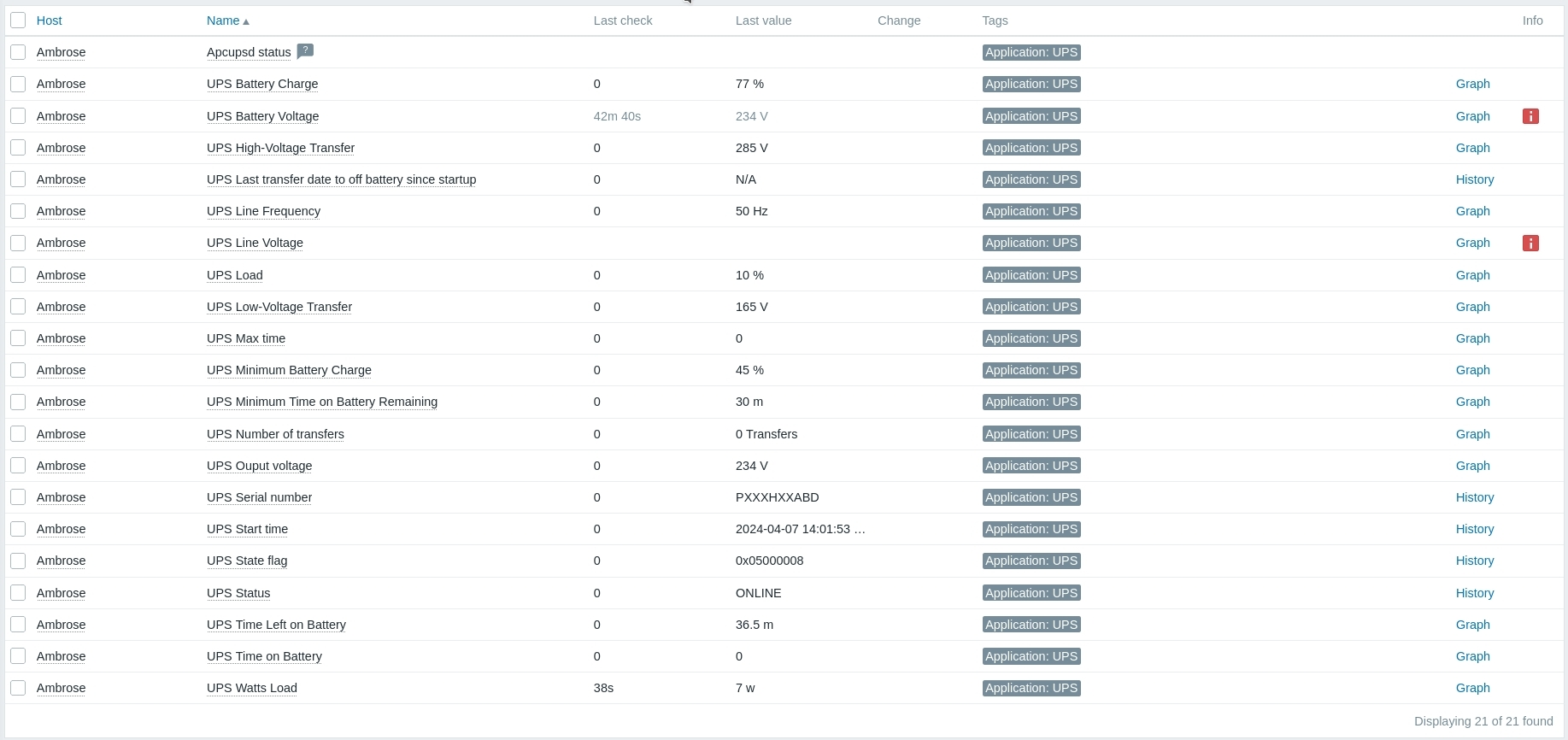
Latest data
Note: some items do not exist on my UPS, they may exist on yours. Feel free to add some missing keys and contact me to update the template.
An item in the Not supported state is not a template bug: apcupsd returns only the fields your model exposes, and a dependent item whose JSONPath finds nothing stays unsupported. On an Ellipse PRO, BATTV is absent and mains voltage is reported as OUTPUTV, not LINEV. Disable the items your model does not provide.
Some notes
I was originally using cavazquez's Zabbix template.